
Policy document
July 17th 1992
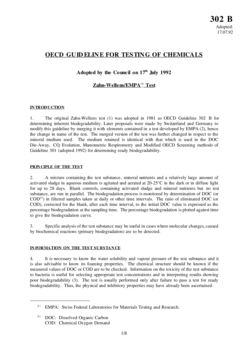
Test No. 302B: Inherent Biodegradability: Zahn-Wellens/ EVPA Test
 IGO
IGO
This Test Guideline describes the Zahn-Wellens/EMPA Test. It is used to determine inherent biodegradability.
A mixture containing the non-volatile and water soluble test substance, mineral nutrients and a relatively large amount of activated sludge in aqueous medium is agitated and aerated at 20-25°C in the dark or in diffuse light, for up to 28 days. Blank controls, containing activated sludge and mineral nutrients but no test substance, are run in parallel. The functional capability of the activated sludge is tested using a reference compound (ethylene glycol, diethylene glycol, lauryl sulfonate or aniline). In a typical run 1 or 2 vessels for the test suspension and for the inoculum blank, 1 for procedure control are used. The biodegradation process is monitored by determination of DOC, Dissolved Organic Carbon, (or COD, Chemical Oxygen Demand) in filtered samples, taken at daily or other time intervals. It is mandatory to follow DOC in the test suspension and inoculum blanks in parallel. The ratio of ...
Hello! You're looking at a policy document report on Overton
We track government policy, guidelines, think tank research, working papers and more to help our customers see the impact and influence of their work. Are you interested in seeing what information we have to offer?
If you fund, produce or manage research or work to influence policy, we'd love to talk.
Identifiers
Overton ID
oecddiscovery-0c596f5005b0f5d71ec31391ba0be3ef
Topics in this document
Chemical compounds
Manufacturing
Chemical substances
Materials
Physical sciences
Chemistry
Artificial materials
Chemical oxygen demand
Calcium chloride
Dissolved organic carbon
Chemical substance
Filtration
Biochemical oxygen demand
Purified water
Ethylenediaminetetraacetic acid
Water
Biodegradation
Activated sludge
Iron(III) chloride
Solubility
Phosphate
PH
Hydrogen peroxide
Sewage sludge
Sodium
Chemical engineering
Potassium
Nature
Chloride
Environmental technology
Related SDGs
SDG 12: Responsible Consumption and Production
SDG 12: Responsible Consumption and Production
Target 12.4
Achieve the environmentally sound management of chemicals and all wastes throughout their life cycle, in accordance with agreed international frameworks, and significantly reduce their release to air, water and soil in order to minimize their adverse impacts on human health and the environment
Related COFOG Divisions
Citations
Cited by 11
other policy documents
(10 of them are from other policy sources)