
Policy document
September 21st 1998
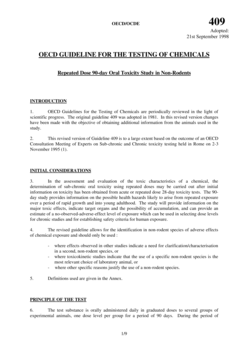
Test No. 409: Repeated Dose 90-Day Oral Toxicity Study in Non-Rodents
 IGO
IGO
This method provides information on health hazard likely to arise from short-term exposure to test substance. The determination of sub-chronic oral toxicity using repeated doses may be carried out after initial information on toxicity has been obtained from acute or repeated dose 28-day toxicity tests.
The method is based on the repeated oral administration of the substance of interest over a prolonged period (one dose level daily during 90 days). This Test Guideline is intended primarily for use with non-rodents species. The commonly used non-rodent species is the dog (the beagle is frequently used). At least 8 animals (4 female and 4 male) should be used for each test group. Three concentrations, at least, should be used. The test compound is administered in the diet or in the drinking water, by gavage or in capsules. A limit test may be performed if no effects would be expected at a dose of 1000 mg/kg bw/d. The results of this study include: measurements (weighing at least once a week, food/water consum...
Hello! You're looking at a policy document report on Overton
We track government policy, guidelines, think tank research, working papers and more to help our customers see the impact and influence of their work. Are you interested in seeing what information we have to offer?
If you fund, produce or manage research or work to influence policy, we'd love to talk.
Identifiers
Overton ID
oecddiscovery-19ca026fbd817cc77daa497dad8ad05c
Topics in this document
Related SDGs
SDG 12: Responsible Consumption and Production
SDG 12: Responsible Consumption and Production
Target 12.4
Achieve the environmentally sound management of chemicals and all wastes throughout their life cycle, in accordance with agreed international frameworks, and significantly reduce their release to air, water and soil in order to minimize their adverse impacts on human health and the environment
Related COFOG Divisions
Citations
Cited by 57
other policy documents
(52 of them are from other policy sources)