
Policy document
May 12th 1981
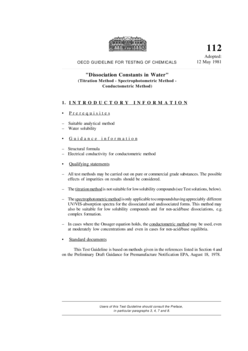
Test No. 112: Dissociation Constants in Water
 IGO
IGO
This Test Guideline describes the methods allowing the determination of the dissociation constants in water. The dissociation is the reversible splitting into two or more chemical species which may be ionic.
The determination of the dissociation constant requires a measure of the concentrations of the dissociated and undissociated forms of the chemical substance. From a knowledge of the stoichiometry of the dissociation reaction the appropriate constant can be determined. In the particular case described in this Guideline the substance is behaving as an acid or a base, and the determination is most conveniently done by determining the relative concentrations of ionised and unionised forms of the substance and the pH of the solution. The relationship between these terms is given in the equation for pKa. Some compounds exhibit more than one dissociation constant. Some of the methods described are also suitable for non-acid/base dissociation. There are two basic approaches to the determination of pKa. One inv...
Hello! You're looking at a policy document report on Overton
We track government policy, guidelines, think tank research, working papers and more to help our customers see the impact and influence of their work. Are you interested in seeing what information we have to offer?
If you fund, produce or manage research or work to influence policy, we'd love to talk.
Identifiers
Overton ID
oecddiscovery-21d4c7749f8a411f60c869413f4dc542
Topics in this document
Materials
Analysis
Equilibrium chemistry
Chemistry
Acid dissociation constant
Physical chemistry
Applied and interdisciplinary physics
Analytical chemistry
Chemical substances
Physical sciences
PH
Titration
Conductivity (electrolytic)
Solubility
Dissociation (chemistry)
Buffer solution
Acid
Solution (chemistry)
Base (chemistry)
Branches of thermodynamics
Chemical compounds
Artificial materials
Spectrophotometry
Related SDGs
SDG 6: Clean Water and Sanitation
SDG 6: Clean Water and Sanitation
Target 6.3
Improve water quality by reducing pollution, eliminating dumping and minimizing release of hazardous chemicals and materials, halving the proportion of untreated wastewater and substantially increasing recycling and safe reuse globally
Citations
Cited by 20
other policy documents
(10 of them are from other policy sources)