
Policy document
July 27th 1995
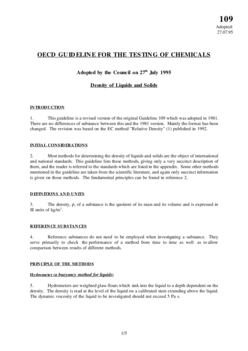
Test No. 109: Density of Liquids and Solids
 IGO
IGO
This Test Guideline lists methods for determining the density of liquids and solids, giving only a very succinct description of them. The density of a substance is the quotient of its mass and its volume and is expressed in kg/m3. Several methods are for liquid substance only: hydrometer, immersed body method (both are buoyancy methods) and oscillating densitometer. These methods are applicable to liquids with a dynamic viscosity below 5 Pa s for hydrometer and oscillating densitometer and below 20 Pa s for immersed body method. The method for solids only is the air comparison pycnometer. The volume of a sample of the solid is measured in air or in an inert gas in a calibrated cylinder of variable volume. After concluding the volume measurement, the sample is weighed. The methods for liquids and solids are the hydrostatic balance (a buoyancy method) and the pycnometer. The dynamic viscosity of liquids to be investigated should not exceed 5 Pa s for hydrostatic balance, and should not be above 500 Pa s for ...
Hello! You're looking at a policy document report on Overton
We track government policy, guidelines, think tank research, working papers and more to help our customers see the impact and influence of their work. Are you interested in seeing what information we have to offer?
If you fund, produce or manage research or work to influence policy, we'd love to talk.
Identifiers
Overton ID
oecddiscovery-3c2151039bfd8c7f92dfcbd4d1c9f2fc
Topics in this document
Quantity
Nature
Physical sciences
Buoyancy
Chemistry
Physics
Scalar physical quantities
Applied and interdisciplinary physics
Continuum mechanics
Mass
Density
Relative density
Volume
Liquid
Physical quantities
Metrology
Liquids
Weight
Phases of matter
Materials
Size
Physical chemistry
Gases
Transparent materials
Soft matter
Classical mechanics
Related COFOG Divisions
Citations
Cited by 9
other policy documents
(6 of them are from other policy sources)