
Policy document
October 16th 2008
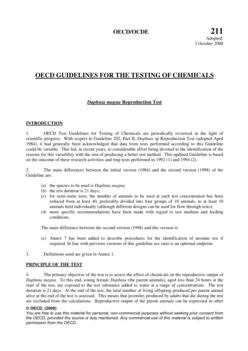
Test No. 211: Daphnia magna Reproduction Test
 IGO
IGO
The test method described in this Test Guideline assesses the effect of chemicals on the reproductive output of Daphnia magna Straus. To this end, young female Daphnia are exposed to the test substance added to water at a range of concentrations (at least five). For semi-static tests, at least 10 animals at each test concentration and for flow-through tests, 40 animals divided into four groups of 10 animals at each test concentration, are used. The test duration is 21 days. Reproductive output of the parent animals and the total number of living offspring produced per parent alive at the end of the test should be reported. The study report should also include: the daily counting of the offspring, the daily recording of the parent mortality, the weekly measurement of oxygen concentration, temperature, hardness and pH values and the determination of the concentrations of test substance. Optionally, the sex ratio of the offspring may be recorded. The reproductive output of the animals exposed to the test subs...
Hello! You're looking at a policy document report on Overton
We track government policy, guidelines, think tank research, working papers and more to help our customers see the impact and influence of their work. Are you interested in seeing what information we have to offer?
If you fund, produce or manage research or work to influence policy, we'd love to talk.
Identifiers
Overton ID
oecddiscovery-86e6ed056108de927b1817a3facbf15a
Topics in this document
Related SDGs
SDG 12: Responsible Consumption and Production
SDG 12: Responsible Consumption and Production
Target 12.4
Achieve the environmentally sound management of chemicals and all wastes throughout their life cycle, in accordance with agreed international frameworks, and significantly reduce their release to air, water and soil in order to minimize their adverse impacts on human health and the environment
Related COFOG Divisions
Citations
Cited by 26
other policy documents
(22 of them are from other policy sources)