
Policy document
November 23rd 2004
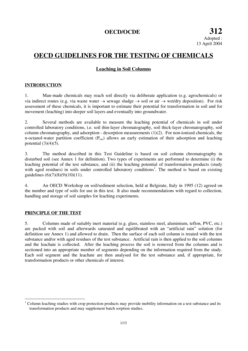
Test No. 312: Leaching in Soil Columns
 IGO
IGO
The method described in this Test Guideline is based on soil column chromatography in disturbed soil. Two types of experiments are performed to determine (i) the leaching potential of the test substance, and (ii) the leaching potential of transformation products in soils under controlled laboratory conditions. At least duplicate leaching columns are packed with untreated, air-dried and sieved soil (< 2 mm) up to a height of approximately 30 cm. Afterwards they are saturated and equilibrated with an “artificial rain” solution and allowed to drain. Then the surface of each soil column is treated with the test substance (non-volatile in water and soil) and/or with aged residues of the test substance. Artificial rain is applied to the soil columns and the leachate is collected. After the leaching process the soil is removed from the columns and is sectioned into an appropriate number of segments depending on the information required from the study. A reference substance (atrazine or monuron) should be u...
Hello! You're looking at a policy document report on Overton
We track government policy, guidelines, think tank research, working papers and more to help our customers see the impact and influence of their work. Are you interested in seeing what information we have to offer?
If you fund, produce or manage research or work to influence policy, we'd love to talk.
Identifiers
Overton ID
oecddiscovery-9ba90574db3075e14ffbb44829ab81a9
Topics in this document
Related SDGs
SDG 12: Responsible Consumption and Production
SDG 12: Responsible Consumption and Production
Target 12.4
Achieve the environmentally sound management of chemicals and all wastes throughout their life cycle, in accordance with agreed international frameworks, and significantly reduce their release to air, water and soil in order to minimize their adverse impacts on human health and the environment
Related COFOG Divisions
Citations
Cited by 12
other policy documents
(11 of them are from other policy sources)