
Policy document
July 27th 1995
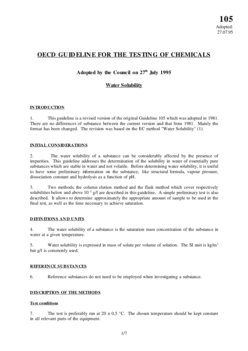
Test No. 105: Water Solubility
 IGO
IGO
This Test Guideline describes methods to determine the water solubility of test substances. The water solubility of a substance is the saturation mass concentration of the substance in water at a given temperature. This guideline addresses the determination of the solubility in water of essentially pure substances which are stable in water and not volatile. Before determining water solubility, it is useful to have some preliminary information on the substance, like structural formula, vapour pressure, dissociation constant and hydrolysis as a function of pH.
The column elution method and the flask method which cover respectively solubilities below and above 10-2 g/l are described. The test is preferably run at 20 ± 0,5 °C. A simple preliminary test is allowed to determine approximately the appropriate amount of sample to be used in the final test, as well as the time necessary to achieve saturation.
Hello! You're looking at a policy document report on Overton
We track government policy, guidelines, think tank research, working papers and more to help our customers see the impact and influence of their work. Are you interested in seeing what information we have to offer?
If you fund, produce or manage research or work to influence policy, we'd love to talk.
Identifiers
Overton ID
oecddiscovery-e91b9b878b179e5c34d9e91c562d1aec
Topics in this document
Concentration
Analytical chemistry
Chemistry
Physical sciences
Solubility
Applied and interdisciplinary physics
Materials
Manufacturing
Physical chemistry
Water
Chemical equilibrium
PH
Chemical substance
Solution (chemistry)
Mass concentration (chemistry)
Elution
Pump
Temperature
Glass
Purified water
Chemical substances
Chromatography
Analysis
Chemical engineering
Citations
Cited by 57
other policy documents
(35 of them are from other policy sources)